
                  |
         Findings at an archeological site near Oaxaca, Mexico
date the celebration of the Day of the Dead back to
1800BC. but with the arrival of the Spanish Conquistadors
in 1521, came the destruction of indigenous culture in
Mexico. Rather than abandoning their traditions,
the people of Mexico incorporated their Day of the
Dead with the Catholic's All Saints Day. Although
both days fall on November 2, the Day of the Dead
festivities begin on October 1- the date the dead
return to visit their living relatives.
 Unlike the Spanish, the indigenous Mexicans believed,
and still do believe, that death is a continuation of life.
Instead of fearing death, they embraced it. To them
life was a dream and only in death did they beome
truly awake.
 During the Day of the Dead, the Mexican people
decorate gravesites with cempazuchitl (yellow
marigolds- the traditional symbol of death), and
decorated sugar calvera (skulls). At home, altars are
made with ofrenda for the dead- food, alcohol, incense,
music, cigarettes- whatever the dead enjoyed during
their life is offered to them at the altar.
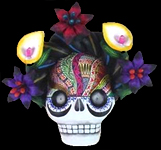 Today the festive character of the Day of the Dead
has come to surpass its religious function, marking it as
one of the most acclaimed cultural events on the
Mexican calendar. Celebrations are held in zocalos
(the main squares) to remind tourists of the Mexican
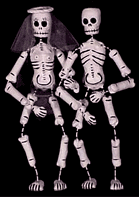
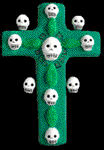
fascination with death and flowers. Papier mache
skeletons are popular, as are cardboard coffins,
masks, and paper banners.
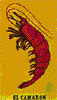
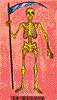
 The borders of this page are made from a Mexican
game called Loteria which can be bought from
Latinworks Co.com
|
               |